
Upper Moreland Township Previous Resident Sources
Previous residents are found through sources that cover different periods and different events. The strongest starting point is the modern parcel record, because it leads to a deed or plan reference. The deed chain then supplies the ownership sequence. Period telephone books and directories can add a dated subscriber or address clue, and released census material can place a household in a period. Township files and historic-property sources can date construction or public administrative activity, but neither replaces the deed trail.
Choose a source that matches the time being researched. A present-day property search cannot prove an earlier household. A telephone directory cannot establish every person at an address. Recorder files reach the county’s early record period, but their index, book, and image access differs by series and channel. Treat gaps as part of the record story and preserve the repository, date, page, document number, parcel, and legal-description details needed to repeat the work.
| Source | Years it covers | Where held | What it shows |
|---|---|---|---|
| Recorder land records | 1784 to present, subject to access conditions | Recorder PAS, counter, or mail | Deeds, mortgages, satisfactions, plans, and legal-description links. |
| Probate docket books | 1784-1987 | Register of Wills genealogy route | Estate trail, executors, and heirs. Computer probate records begin in 1988. |
| County birth and death material | 1893-1915 | Register and Archives genealogy route | Historical vital link requiring custodian and eligibility checks. |
| Suburban telephone directory | August 1939-May 1940 | Library of Congress | Listed telephone subscriber and address-locality evidence, not a full occupancy list. |
| Related metro directories | 1914-1930; 1938-1939 | Library of Congress collections | Comparative period volumes; locality inclusion must be checked. |
| Federal census | Public releases through 1950 | Federal archival and library research services | Period household and place context when paired with a directory year. |
| Township files | Local series; online historical coverage not located | Code Enforcement and RTKL route | Construction, inspection, maintenance, planning, or ZHB timing evidence. |
Note: A source can provide a period lead without proving every person who lived at an address.
Start an Upper Moreland Township Address Trail
Begin with the present form of the address in Montgomery County Property Records. The form supports address and parcel searches, while direct owner-name searching was removed in 2022. Record the parcel ID, UPPER MORELAND municipality, official property location, any displayed current owner or mailing fields, and sale or book/page clues. The property record is the bridge to Recorder research, not a finding about who occupies the property today.
Keep address variants in a small timeline. Include the exact current form, historic spellings, road or subdivision clues, postal label, parcel, and legal description. Willow Grove and Hatboro labels can appear around Upper Moreland Township, and postal geography is not the same thing as a Township boundary. When the address is not stable in an early source, the lot, block, subdivision, plan, and legal description can carry the trail farther than a street number.
Use the County Open Data mapping resources or assessment Map Search only after the parcel is known. The County warns that GIS layers are informational and are not legal descriptions. A map can help orient a parcel, but the assessment record and recorded document remain the sources to compare.
Trace Upper Moreland Township Previous Residents
The backward deed chain is an ownership trail and a key framework for researching previous residents. From the parcel record, find the most recent acquisition instrument in the Recorder index. Capture the grantor, grantee, recording date, document or book/page reference, legal description, subdivision or lot/block detail, and parcel reference where shown. Next, search the seller as a grantee to locate that party’s own acquisition document. Repeating this handoff works because the Recorder identifies its records by party name rather than by address alone.
- Search the current address or parcel in Property Records and preserve the official location, parcel, and any sale or book/page clue.
- Use the Recorder Quick Search or the authenticated Recorder route to locate the present owner’s acquisition deed.
- Read the document’s grantor, grantee, legal description, plan, lot, block, subdivision, and prior-reference fields together.
- Search the seller as a grantee to find the earlier purchase, then compare the legal description before accepting it as the same parcel.
- Repeat backward. When remote access does not resolve a document, use Recorder counter computers, mail copies, or county archival microfilm guidance.
- Grantor
- The party transferring an interest in a recorded document.
- Grantee
- The party receiving that interest. Searching a prior seller as grantee can reveal the earlier acquisition.
- Chain of title
- The sequence of recorded transfers and related instruments associated with the same property interest.
- Legal description
- The recorded lot, block, subdivision, plan, or other property language that can remain useful when a street form changes.
Note: A deed chain traces recorded property interests, not every past person connected with an address.
Upper Moreland Township Recorder Paths
The Recorder says county records date to 1784 and offers current and historical document research. Search access is not a single online cutoff. Its Public Access System requires an account for remote searching, and remote document-image viewing requires a subscription. The office also has counter computers and a mail-copy route. For a mail request, provide the owner name, full address with municipality, parcel ID, book/page if known, contact information, payment, and a self-addressed stamped envelope. E-certified copies are available through the system, and the office lists a $10.50 certified-copy price.
Some historical book ranges are missing, including certain deed, mortgage, and plan books. Record the gap and continue through available grantor/grantee indexes, legal descriptions, plan references, historical maps, county archival material, or the Recorder’s historical resources. Do not turn a missing volume or an account limitation into a claim that a property has no earlier record.
Review the Recorder Public Access System before choosing a search, copy, or counter route.
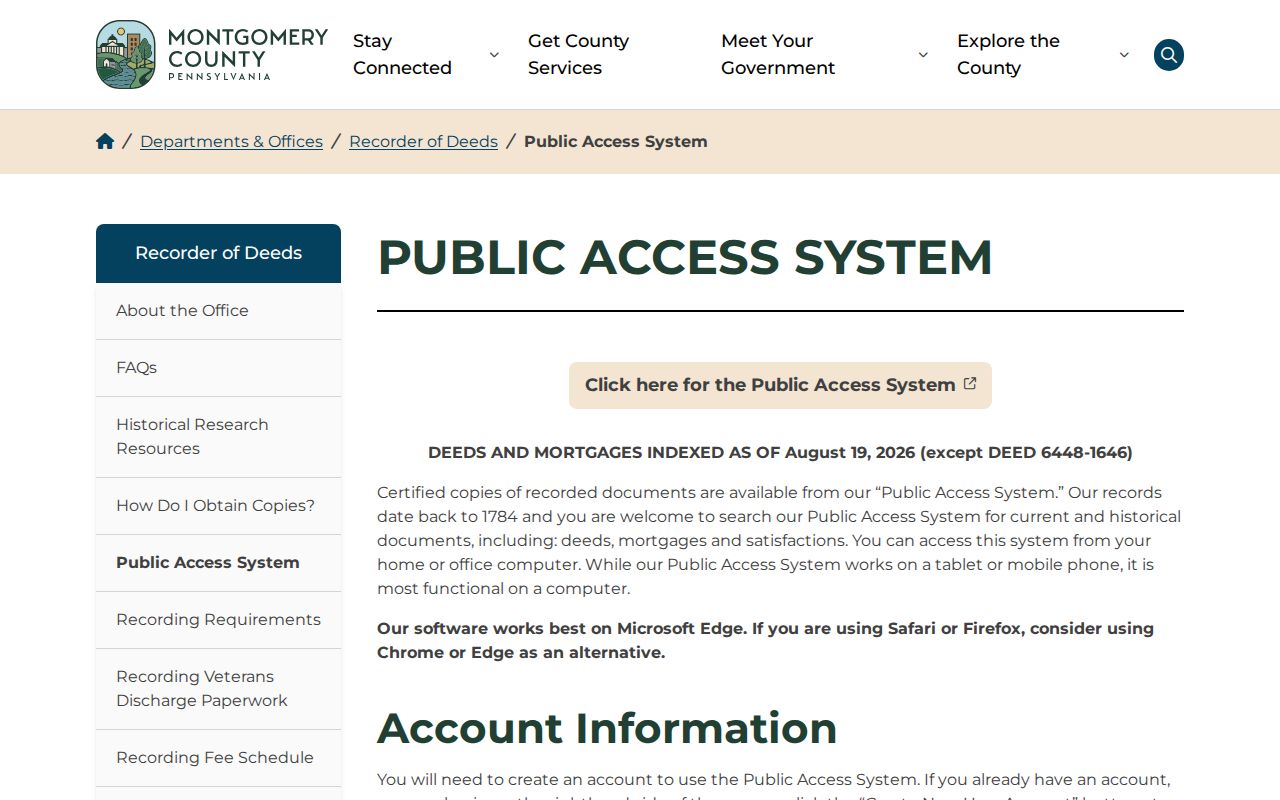
The Recorder page is the appropriate access point for a deed-chain image request, subscription decision, or counter-copy question.
Moreland Before Upper Moreland Township
The older Moreland Township was divided into Upper and Lower Moreland in 1916. That fact changes how early previous-resident research should be routed. Before the split, deeds, tax lists, directories, court references, maps, and notices can legitimately say “Moreland Township.” Keep that jurisdiction name exactly as printed and search the county and state repositories under the period’s wording. A pre-split listing is a predecessor-jurisdiction lead, not a reason to rewrite an early record with the later Township label.
The MCLINC catalog identifies a 1900-1902 Montgomery County directory whose Township residents were listed with post-office addresses from assessors’ lists. Its Ludington Library copy is reference-only. This is a useful pre-split bridge, but record its title, date span, page, post office, and historical municipality rather than treating it as a modern address directory.
Upper Moreland Township Past Resident Periods
Once the deed trail identifies a time period, period directories and census material can add household context. The Library of Congress suburban Philadelphia telephone directory from August 1939 to May 1940 is a documented source, and the Library’s guides explain that surname and address-arranged directories are separate publication types. The 1950 federal census is the newest released decennial census at the research date. A single absence from one volume may reflect a coverage gap, a spelling difference, or a non-subscribing household rather than a move.
- Write the directory title, publication date, locality wording, page or image, and surname or initial variant exactly.
- Check whether an address or criss-cross volume exists for the same locality and period.
- Repeat the search in more than one year before concluding that a household changed.
- Pair the directory year with the nearest released federal census and compare the place carefully.
- Return to deeds, probate, maps, or an obituary source to test the period lead independently.
The Upper Moreland Township City Directory covers the historical collection routes in more detail. For a backward address trail, use each collection as a dated checkpoint rather than rebuilding its entire shelf here.
Upper Moreland Township House Files
Township administrative records may provide a separate date anchor. Code Enforcement keeps permit, inspection, property-maintenance, zoning, planning, ZHB, and subdivision records. No public historic permit-result search was located, so the appropriate approach is a narrowed address, record type, and time period through Code Enforcement, a call or appointment, or an RTKL request. A permit can date proposed or approved work. It does not establish occupancy or replace a deed.
The Upper Moreland Historical Commission inventory can supply an approximate construction year, description, and historical context for an inventoried resource. It is available for public inspection through the Township, and may be available through the library or historical association. County archival material also offers a walk-in route, request form, and department-by-department microfilm list, but cannot certify documents. These are useful fallback channels when an online index does not reach a needed period.
Keep Upper Moreland Township Legal Clues
Parcel ID and legal description are the durable handoff between the assessment record and a chain of title. Preserve them before moving to Recorder deeds or plans. Plans can translate a current address into a lot, block, subdivision, or older road reference. The Recorder’s plan-search instructions use special book formats, including hyphen-to-zero conversion in lettered plan books and particular volume formats for some plans. Those details can matter when a modern address stops appearing in older records.
Historic-property research should also retain the source of each claim: repository, catalog or item identifier, volume, date range, printed page or scan number, and the exact address or legal-description variant. A house-history narrative can be informative, but it is not legal title evidence. Independent support from a deed, map, permit, tax list, probate file, newspaper, or second directory is stronger than continuity assumed from a similar street name or surname.
Respect Upper Moreland Township Previous Residents
Previous-resident research fits family history, property history, estate questions, and personal curiosity when it stays tied to official and period sources. Past records can be incomplete, can use old names or addresses, and can contain facts that no longer apply. Confirm a meaningful record with the responsible custodian and retain its date rather than treating a historical entry as a current contact finding.
Lawful use. Do not use address history, deed parties, directories, or archival records to stalk, harass, monitor, or harm a living person. Respect protected addresses and each custodian’s access limits.